
Northern Hills Homeowners Association
San Antonio, Texas


Last update December 9, 2023
Wildlife Rescue & rehabitation = 24-Hour Hotline 830-336-2725
The Humane Society SPCA of Bexar County has made a pair of changes. The organization has changed its name to
"The Humane Society of San Antonio" and is starting a new Spay-Neuter Clinic every Friday.
Clinics are held at The Humane Society facility located at 4804 Fredericksburg Road.
The Spay-Neuter Clinic is open to low inclome families, animal organizations and the general public. Specials will be offered ranging from between $25 and $100.
Call the SPCA for more information at 226-7641
If you have lost your pet, here is what you can do to find it as soon as possible:
To report Lost or Found Pets, please use the "Nextdoor" community website.
Good Neighbors
There are many ways we can be good neighbors and help keep our neighborhood safer and cleaner.
Have a visible street address on your home to assist first responders and deliveries.
Experts encourage us not to feed the ducks in the neighborhooid.
Due to the overpopulation of racoons, opossums and skunks in Northern Hills, it is best not to leave pet food out after dark.
Free pet services:
City residents get FREE registered microchips for your pet at ACS, 4710 State Hwy 151, M-F 11-7, wknds 11-5.
City residents get FREE & LOW COST pet shots & services at ACS, 4710 State Hwy 151, Mondays 2pm-5pm.
FREE Spay/Neuter for your dog or cat. Check with A.C.S. for zip codes that qualify. Contact SpaySA, SNAP, SA Humane Society, Animal Defense League or Pet Shotz.
City Dog Parks
Come visit at Lady Bird Johnson Park on Nacogdoches or McAllister Dog Park just off HArry Wursbach Parkway north of the airport.
City Animal Licensing Laws:
In case anyone missed it-- San Antonio passed a law passed April 2015 requiring dogs, cats and ferrets in the city limits to be microchipped-- it is not optional and you can read about it here:
http://www.sanantonio.gov/AnimalCare/Wha...
Microchips are a great way to get your dog back home, but as volunteer with a rescue, I can tell you that a collar with ID tags is a fast way to get your dogs home and your dog is MORE likely to be picked up by a well-meaning person if they are wearing tags. A microchip is like insurance-- if the tags or collar comes off, a good Samaritan can take your dog to a vet to be scanned for a microchip. If the dog has a collar with a tag, the rescuer can immediately call you or knock on your door. Both are important, and microchips are required now!
Hope this info helps someone keep their furry family safe!
Pet Adoption Service:
If you have a pet that needs a home. I invite you to use the "Nextdoor" website.
Help Protect your pet from disease
Help protect your pets from wild animal diseases. Do not leave food out at night.
Wild animal saliva left behind on your pet's bowl will likely make your pet sick and cost you dearly.
San Antonio Dog Court
Animal Care Services (ACS) now has a "Dog Court" so be a responsible pet owner and avoid fines up to $2,000 per offense!
Attention Barking dog owners
Please keep your dog in late at night if your dog barks alot. Your neighbors will likely get annoyed with lots of late night or early morning barking.
Attention Cat Owners:
Please get your cats spayed/neutered to avoid overpopulation since felines are prolific breeders.
NEW! ACS Website introduces Online Pet Licensing
All owned dogs and cats in the City of San Antonio must be licensed. Now pet owners can get their dog or cat's City license with just a few keystrokes.
Visit http://www.saacs.net today. Animal Care Services' newly revamped website features
a direct link to Pet Data, an online tool that streamlines the pet licensing process. All dogs and cats 4 months of age and older in the City
of San Antonio are required to have a current rabies vaccination and pet license. Annual licenses for sterilized pets are just $5 with licensing for intact
or unsterilized animals set at $50. Online pet licensing is just one part of the shelter's revamped website which features information on the
City's low cost spay/neuter services, vaccination clinics, and special events. The site even features printable applications and forms as well
as pet care tips, wildlife information and resource library.
Free and Low cost Pet Spay and Neuters now available!
SpaySA - 210-351-7729
S.N.A.P. - 210-673-7722
SNIPSA - 210-237-9400
SA Hmane Society - 210-226-7461
Animal Defense League - 210-655-1481
Low Cost Pet Shots:
Animal Care Services, 4710 State Highway 151 from 2pm to 4 pm Every Monday of every month
Shots and other pet services available through their partner, PET SHOTZ. Cash and credit cards only please.
Remember the City Leash Laws
Your dog must be on a leash unless in an enclosed space. If your pet is in your front yard they must be on a leash even if you are outside with them.
If you have them in your backyard, please double check your fence line often, so they do not get out.
Walking Your Dog - City Ordinance Sec. 5-19.- Leash and pooper waste scooping required.
An animal owner or keeper shall not walk an animal without a leash restraint, and shall not guide or take animals onto the yards or driveways
of property not owned, leased or occupied by the animal owner for the purposes of allowing the animal to defecate, but shall keep the animal
in the public right-of way, and shall carry a container and implement for the sanitary removal of the animal's fecal matter from the public
sidewalk and public right-of way adjacent to any property with a structure or other. For more information go to "www.saacs.net"
Smile: Dogs have owners while cats have staff
So you want to breed your pet? -
The realities of pet breeding are:
New Spay-Neuter Clinic
Tips For Finding a Lost Pet

More Ideas for Finding a Lost Pet
 Since some local shelters receive over one hundred stray animals a day, they require that you file a Lost Pet report in-person after touring our kennels. Make a list of shelters, their hours of operation, website links, maps, etc. You should also review photos of strays animals.. currently being cared for. Some lists are updated hourly, but may not include animals currently under medical treatment or DOA animals.
In general, impounded animals are held for 2-3 business days, not counting the day of arrival, Sundays, Mondays, or holidays. We recommend you visit our agency 3 times a week. After the impoundment period, animals are evaluated for health and behavior and at that time, may be re-homed, transferred to another agency, placed into foster care, or euthanized.
Other Ideas for Finding a Lost Pet
It is Most Important to Keep Looking for Your Pet.
Animals turn up at shelters weeks, and sometimes months, after they've been lost. Likewise, finders will sometimes not report a wandering animal to us until weeks after it first appeared in their neighborhood.
...And after you do find your pet:
It is a sad fact the there are people out there that are now stealing small dogs for resale. Please take precautions that this does not happen to your valuable pet. If you are buying or getting a new pet, make a record of how to get back in touch with the person you got it from in the event it is stolen. Invest in the MicroChip and use a collar with an owner identification tag that includes your phone number.
 DOG FOR SALE
 Whether you own a dog or not, you must appreciate the efforts of this owner to sell her dog.
Free to good home. Excellent guard dog.Owner cannot afford to feed him anymore, as there are no more drug pushers, thieves, murderers, or molesters left in the neighborhood for him to eat.
Most of them knew him as 'Holy Crap.'
Given our community’s ongoing animal overpopulation issue, City leaders unanimously approved sweeping changes to the collection of local animal laws known as Chapter 5. The ordinance, which was approved in December 2007, institutes a permitting and licensing process for variety of animal related concerns beyond general pet licensing. One of the most important areas relates to the licensing of intact or unsterilized dog. These permits will go into effect January 1st, 2009.
Effective January 1, 2009, any owner or keeper of a dog that is not spayed or neutered must obtain an annual intact dog permit. There are exemptions for dogs that qualify for certified medical exceptions (from a licensed veterinarian) or dogs less than six (6) months old.
The new law does not apply to:
1) A dog or cat owner who is a nonresident of this City and is keeping the subject pet in the City for fewer than sixty (60) days; or
2) Dog or cat owners who have been a resident of this City for fewer than thirty (30) days.
Permit applications and instructions can be found on this page of the ACS website.
Please see the bottom of the page on this link for an application. Click Here
All fees are payable to the City of San Antonio. Non-compliance with City Ordinance can result in citations and mandatory court appearances.
The complete Chapter 5 ordinance and Animal Care Services fee structure (including permit fees) can be viewed at: www.sanantonio.gov/animalcare/chapter5.asp.
Trap - Set humane traps to capture feral cats from colonies.
The T.N.R. program is the most efficient and humane way to help reduce pet overpopulation of feral cats and improve the health of
feral colonies. Our goal is to spay or neuter the feral cats in a colony to prevent the reproductive cycle. Each trapped cat will be
tested for common viruses, FELV and FIV, if they are found to carry either of these they will be humanely euthanized to protect the
health of the remaining cats in the colony as well as owned cats that may come into contact with them. The cats will be vaccinated,
treated for fleas, worms, and ear mites. A notch or hole will be marked in their ear as a universal sign that they have been TNR'ed.
With over 60 million feral cats in the United States alone, the TNR program has proven to be the most effective and least costly way
to control the situation. TNR is endorsed by the American Veterinary Medical Association.
Volunteers assist with trappings and transport the cats to and from the vet.
Feral Colony Caretakers/TNR locations
Trap On Your Own
For low-cost veterinarians that may be able to spay
and neuter your ferals, please contact webmaster.
If you can, Please Help rescue the 120 or so new arrivals each day by adopting a pet. Approximately 32,000 pets are lost each year in San Antonio.
Do you have wild animals visiting?
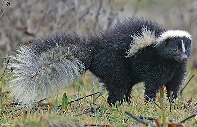
Consider the fact that leaving food and water outside encourages wild animals to come to and from your door at night.
This dramatically increases the opportunity for you and your neighbors to have a surprise confrontation with wild skunks, racoons and possums.
It also encourages supports a growing population of even more homeless pets. Most of these live a very poor existence. Some end up starving or fall prey to coyotes.
Let us suggest that you get the help of an animal rescue organization that will
set a trap after you stop feeding them. Once caught, a participating vet will spay or neuter the animal, provide the necessary
innoculations and either return them to you or find them good homes.
Facts about Cats - The T.N.R. program is working!
Since cats are prolific breeders, a "TNR" program is effective against large colonies. T.N.R. = Trap, Neuter, Return.
Neuter - Transport feral cats to the vet to be spayed/neutered, tested for viruses, vaccinated, de-wormed, and treated for fleas/ear mites.
Return - Release the feral cats back into their feral colony, with their ear notched to identify them as fixed.
The standing alternative to TNR is extermination, which is not only inhumane, but costly as well. Continued attempts to catch feral cats,
house, euthanize, and dispose of them costs much more than to simply TNR them.
In 1997, the San Diego Department of Animal Control showed a decrease of almost 50% in the number of cats
impounded and killed compared to 1992, the year in which their TNR program was started.
If you are caring for a colony of feral cats around Northern Hills that needs TNR, please contact webmaster. Some vets charge $25 to TNR adult cats.
Trapped kittens will be taken into our adoption program and most will not charge for them.
If you would like to trap the cats in a colony yourself, you can
rent a trap for about $10 a week plus a $50 deposit.
 Adopt a Pet from ACS most Sundays from 11:00 am to 3:00 pm
Animal Care Services(ACS) is changing its hours of operations, with the goal of increasing adoptions and improving efficiency at the facility.
For more information, call Craig Brestrup at 210-207-8155. The new hours of operation will be as follows: